
How useful are reference tracks, really?
How to avoid listening overdrive as an artist.

I’m trying to remember the first time I heard the term “reference track” in relation to making music.
It might’ve been my high school band’s first proper recording. The producer asked us what kind of record we wanted to make. I mentioned Blood Sugar Sex Magik by the Red Hot Chili Peppers (of course).
He said, “Yeah, everything on that album sounded great except the kick drum.”
Up until that point I’d never even thought about how a kick drum sounded. Drums were drums. I left that stuff up to the drummer and the recording engineer.
I don’t remember ever comparing our recordings-in-progress to any other music either. Not side by side anyway. Any comparisons would’ve been based on my memory or impression of another record.
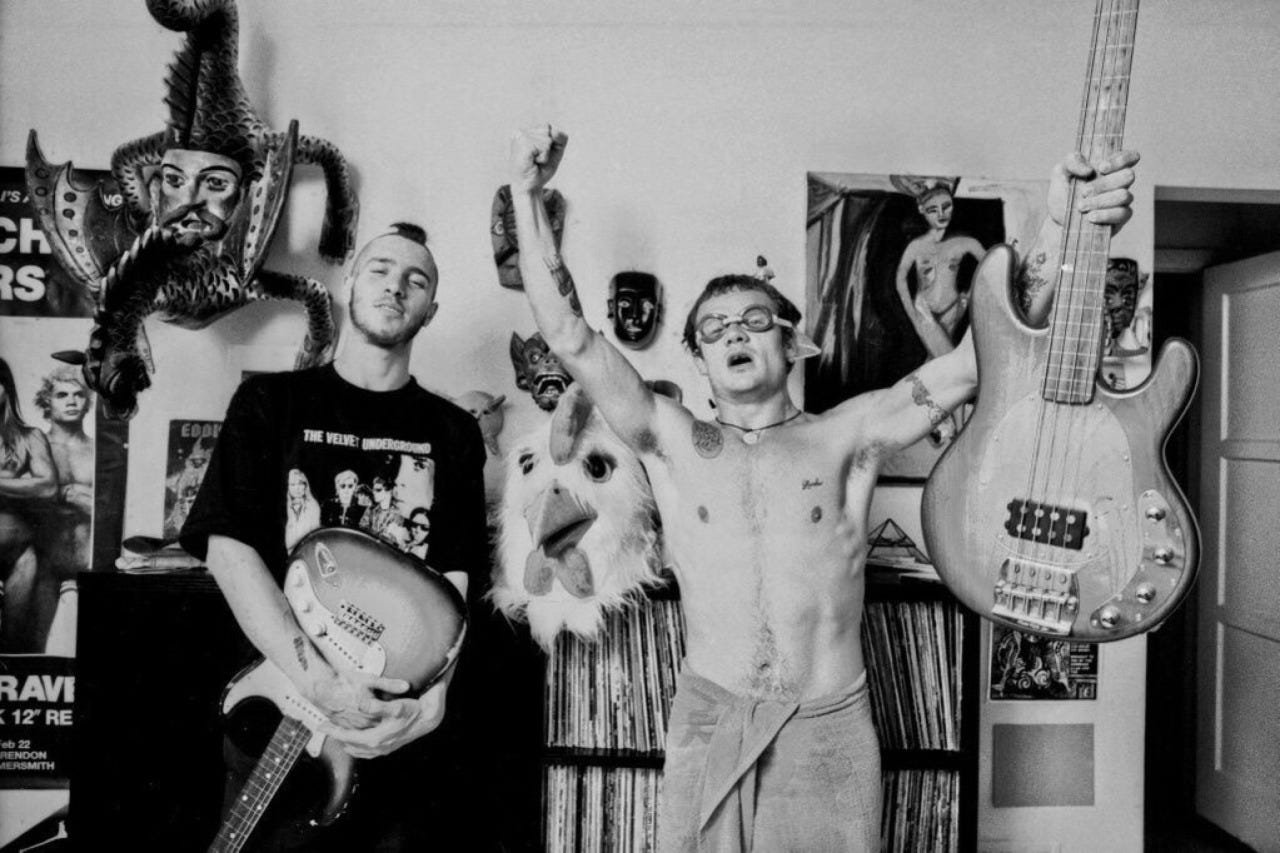
It wasn’t just the Chili Peppers albums that I was obsessed with as a teenager. The creative approach of their guitarist John Frusciante has always captivated me. As well as shamelessly borrowing from his guitar style, I’ve tried to adopt elements of his approach to songwriting too.
Mostly this concept that I heard him describe in an interview: he surrounds himself with music, whether it be through playing along to records on his guitar, studying theory or playing in the band.
He doesn’t feel pressure to write music, but creates the conditions to allow new ideas to emerge.
You can see this principle at work when you hear him describe coming up with the riff to Californication. Him and Flea were listening to a lot of The Cure while making the album. Anthony Kiedis had this melody they’d been playing around with, but John hadn’t yet found a guitar part to accompany it.
After playing along to a 26 minute Cure instrumental called Carnage Visors, an idea came to him for the riff we now know as Californication.
He says, “If you hear it, it sounds like Californication but it’s just different notes. It’s the same rhythm and the same kind of feeling.”
I guess you could call this “referencing,” but it seems more organic than that to me. In one sense he was hunting for the right part, but playing along to records is something he always does. It just happened to be this particular Cure song that day.
In an interview with Rick Rubin he talks more about this:
“What’s turned out to be the most beneficial kind of practicing for me is that I’m just creating a sort of an encyclopedia of what has been done. And that’s all being stored in my subconscious. If I like a song, I learn how to play it, and this information is all stored in my head. So when I write, I’m drawing from that store room. You’re doing this mixing and matching thing it’s really more your subconscious doing it.”
There’s a trap I’ve fallen into before when recording my own music where I go into something I call “listening overdrive.”
Any piece of music I hear, I listen for sounds, feels and ideas I can borrow. I dissect the recording style and the individual parts. I think about what I could combine to create interesting cross-overs and ultimately I keep asking:
“Could this be my new sound?”
I listen like that until it drives me insane and I pretty much stop enjoying music. Then the only albums that can bring me back are Neil Young’s Harvest or Miles Davis’ Kind of Blue.
I’m sure you can already see the ridiculousness of what I just described. Trying to find my sound by frantically listening to the sounds of others. If anything, my sound is being drowned out by doing that.
It’s nothing like Frusciante’s process of playing along to music he loves and allowing ideas, sounds and inspirations to naturally ebb and flow.
I think I’ve only started listening like that since streaming came along.
I can remember reading an interview with Robin Pecknold from the Fleet Foxes in the days before streaming, where he admitted to illegally downloading music on file sharing services. “I’ve downloaded hundreds and hundreds of records…That was how I was exposed to almost all of the music that I love to this day.”
This was all the justification I needed as a 23 year old musician with only 3 shifts a week at JB HiFi to pay the rent. And I discovered some incredible music through torrent sites. They let me hear Miles Davis’ Sorcerer, CAN’s Tago Mago, Edgar Froese’s Epsilon in Malaysian Pale and I think even Talk Talk’s Spirit of Eden .
It was a way I could deep dive down musical rabbit holes without going completely broke.
But there were still limits. If you wanted to find an album, there was no guarantee someone would’ve uploaded it to share. The internet was slower back then. Plus I still felt bad about stealing.
There was more friction than there is now. And even with a stash of torrented albums to add to my CD and vinyl collection, I still had a limited selection. This definitely helped me ingest, understand and appreciate the music in a deep way.
I studied Sorcerer, Epsilon… and Spirit of Eden because I loved them. Their textures, sounds and approach naturally infiltrated my writing and recording style. But I would never open up one of those tracks in the studio and reference it.
The first time I witnessed someone do that was in a writing session around 2016. I walked into the studio and the first thing I saw on the computer screen wasn’t Pro Tools, Ableton or Logic - it was Spotify.
Is it possible that the ease and access that Spotify allowed has driven the inescapable emphasis on reference tracks that pervades so much of today’s music making?
Influences could be thought of as internalised references. And these seem to me to live more harmoniously with the creative process of an artist finding their own sound.
I’ve spent entire recording sessions thinking I was recreating the vibe of one of my influences, only to find I’d completely missed the mark, but created something that felt like me.
In the writing session I mentioned, the producer set the goal: “We’re trying to make something like this.” As in, let’s go into listening overdrive and figure out what’s going on in this record. And then do the same. It’s not about each person in the room being themselves, it’s about reverse-engineering something someone else has already done and then re-doing.
One of the worst parts about becoming a music producer is realising that anything can be anything.
You wanna sound like The War On Drugs? We can do that. What about the new Gracie Abrams record that you’ve been obsessed with? Yep. Your music can sound like that if you want.
The problem is - what do you actually sound like?
There’s a great quote from Radiohead’s producer Nigel Godrich talking about the song True Love Waits: “We tried to record it countless times, but it never worked …To Thom [Yorke]’s credit, he needs to feel a song has validation, that it has a reason to exist as a recording. We could do True Love Waits and make it sound like John Mayer. Nobody wants to do that.”
I had this conversation with an artist recently where I suggested that the way you sound is a bit like your family - you’re stuck with it. You can’t choose your family, and you can’t choose how you naturally sound.
I’m not saying you can’t change and develop as an artist, but “your sound” is as much an acceptance thing as it is a seeking thing.
Quincy Jones talks about the balance between technique and emotion in music. When asked about how he developed his skills as an arranger he quickly answers, “Work and study.”
But he goes on to explain, “Music is always left and right brain. Intellect and emotion. And you’ve got to work to keep the science going. You don’t work to keep the science going, you can’t support the emotion.”
He studied harmony, counter-point, arrangement and composition for 28 years before he stepped foot in a studio. And he didn’t stop studying. It’s what let him keep evolving era after era. But somehow I can’t imagine him opening up Spotify and kicking off a session with a reference track.
When I’m working with artists as a producer I do want to understand what kind of record they want to make. I’m just not sure if asking for “reference tracks” is the best way to do that.
I want to hear the music they grew up listening to, and the records that have had the biggest impact on them. But mostly I want them to trust their own internalised references (…influences) to ultimately help them sound like themselves. And I want to trust that for myself too.
So... what were your favourite records growing up??
Music I mentioned in this post:
I do think it's an acceptance thing, more than a seeking thing. It has been for me, at least. My favorite is Hendrix, but I'm very different from him as a person, so I do think it's been a journey of accepting who I am and then making music that reflects that.
I recently imagined the use of reference tracks a related to the visual idea of figure and ground.
The actual song is the figure, the focal point in front, and reference tracks are the ground, the setting, the space and supporting environment that give the figure context. Reference tracks give the actual song a space, a background, an idea of where it exists, and hence help to make decisions about how to colour it, shade it, do the lighting, and so on.
But painting the background first without any sense of the figure it doing it totally backwards. Which is the kind of thing you’re getting at with this critique, I think.